
Automatic Gate Safety: What Every Site Manager Needs to Know

Automatic gates provide controlled access, perimeter protection and smoother vehicle movement. They are also powered machinery. If a gate is poorly designed, incorrectly adjusted or not maintained, it can create serious crushing, trapping, impact and shearing risks.
For site managers, facilities managers and other duty holders, automatic gate automation is not simply a matter of choosing a motor and connecting a keypad. The complete installation must be assessed, tested, documented and maintained for the people who use or approach it.
This applies to commercial premises, schools, residential developments, managed apartment blocks, car parks and private entrances.
Safety Starts With The Whole Gate
A powered gate is made up of more than the gate leaf and motor. Its safety depends on how the physical structure, control equipment, sensors, wiring and operating method work together.
The Health and Safety Executive guidance on powered doors and gates makes clear that safety must be considered at design, installation, use and maintenance stages. The gate should respond safely to foreseeable interactions, including children approaching it, vehicles stopping in the wrong position, wind loading, debris and component wear.
A proper assessment should consider:
- How the gate opens, closes and reverses.
- Who may use or approach the entrance.
- Whether pedestrians and vehicles share the same route.
- Where the controls are positioned.
- What happens if a safety device fails.
- Whether the gate can be released during an emergency.
- How the system will be inspected and serviced over time.
Safe operation is designed in, tested and maintained.
Identify Every Crushing And Trapping Point
The most obvious hazard is often the moving gate edge. However, it is not the only risk point.
A risk assessment should examine:
- The leading edge of a sliding or swing gate.
- Hinge areas where gaps reduce as the gate moves.
- Spaces between a sliding gate and a wall, post or fence.
- Gaps between telescopic gate leaves.
- The lower edge of a swing gate.
- Drive mechanisms, rollers and exposed moving parts.
- Areas where a person could be struck by a moving leaf.
- Locations where a vehicle could be hit or trapped.
- Gaps that could catch hands, clothing or other body parts.
Sliding gates require particular attention behind the gate and along the run-back area. A person may be able to walk into a dangerous shear zone unless suitable fencing or guarding is provided.
Swing gates can create crushing points near hinges, posts and walls. Force limitation alone may not adequately control every hazard, especially close to the pivot point. The physical layout must be reviewed before choosing the automation equipment.
This is why a reliable security gates installation begins with the site, not with a standard motor package.
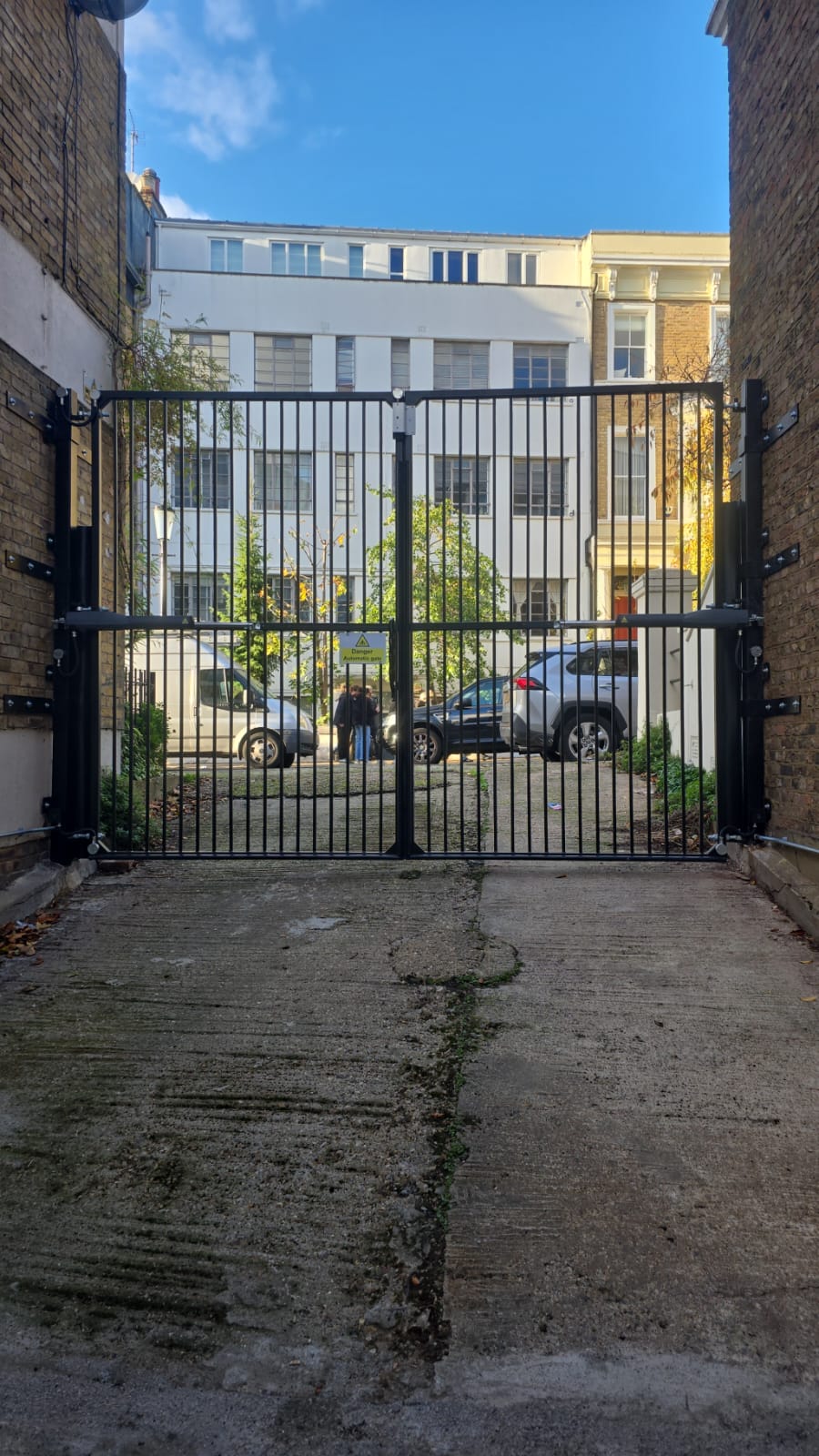
Use More Than One Safety Measure
Industry guidance commonly recommends at least two different types of safety device on a fully automatic gate. The exact arrangement should follow a site-specific risk assessment, but the most familiar combination is:
- Non-contact detection, such as photocells or a suitable light curtain.
- Contact protection, such as pressure-sensitive safety edges.
Each device has a different role.
Safety edges
Safety edges are pressure-sensitive strips fitted to hazardous moving edges. If the edge contacts a person, vehicle or obstruction, the gate should stop and normally reverse far enough to reduce the risk of continued trapping.
They may be required on:
- Sliding gate leading edges.
- Swing gate closing edges.
- Hinge-side risk areas.
- Lower edges.
- Points where the gate passes close to a wall, post or fence.
The edge must be correctly sized, securely fixed and connected to a compatible monitored control system. A damaged, disconnected or poorly positioned edge cannot provide dependable protection.
Photocells and detection
Photocells use an infrared beam to detect an interruption across the entrance. If the beam is broken, the gate should stop or reverse according to its programmed safety response.
Photocells can help prevent a gate from closing on a person or vehicle in the opening. Multiple detection zones may be needed where there are different pedestrian approaches, vehicle paths or swing areas.
A simple single-beam photocell should not automatically be treated as complete protection. HSE and industry guidance recognise that basic beams can sometimes be stepped over, walked around or affected by dirt, rain, snow and vegetation. They are often a supporting measure rather than a complete solution.
Detection should be selected and positioned around the actual hazards.
Force Limits Must Be Tested
Many gate systems use motor force limitation as part of their safety strategy. This means the drive should limit the force applied when the gate meets an obstruction.
The important point is that a motor setting is not proof of safe performance.
Where force limitation is used, the completed installation should be tested with suitable calibrated equipment at the relevant test points. The test should cover the areas where crushing, impact or shearing could occur. The results should be recorded and retained with the gate documentation.
A proper force test should include:
- The correct calibrated testing equipment.
- The test positions relevant to the gate design.
- Repeated measurements where required.
- Recorded results and pass or fail outcomes.
- Details of the tester and test date.
- Any remedial work or adjustments completed.
Force can change over time. Hinges wear, rollers deteriorate, motors are adjusted, foundations move and wind conditions affect performance. Regular force testing is therefore an important part of planned maintenance, not just a commissioning exercise.
Emergency Release Must Be Practical
A gate may need to be opened during a power cut, fire alarm, equipment fault or entrapment incident. The emergency arrangement must be more than a line in the installation manual.
Site managers should confirm:
- Where the manual release is located.
- Who has access to the release key or tool.
- That the release can be operated without delay.
- That staff understand the procedure.
- That emergency routes are not dependent on one person being present.
- Whether the gate fails open, fails closed or requires manual intervention during a power failure.
- That emergency controls and stop devices are clearly identified and tested.
Instructions should be available to authorised users and included in site procedures. For larger premises, the gate should also be considered within fire, evacuation and business continuity arrangements.
A safety feature is only useful when people can find it and use it.
Signage Helps Users Make Safe Decisions
Warning signs and markings do not replace physical safeguards. They do help communicate residual risks and guide behaviour.
Depending on the location, signage may indicate:
- Automatic gate operation.
- Keep clear of the moving gate.
- Pedestrian routes.
- Vehicle-only access.
- No climbing or riding on the gate.
- Manual release instructions.
- Emergency contact details.
Warning markings should remain visible, securely fixed and positioned where users can see them before entering the movement area. On busy entrances, clear separation between pedestrians and vehicles is also important.
Good commercial security systems combine physical protection, controlled access and clear information. Access control, intercoms, CCTV and gate automation should support safe movement rather than introduce new hazards.
What A Proper Gate Safety Inspection Should Include
A visual check is useful, but it is not a complete safety inspection. A planned visit by a competent gate specialist should examine the whole installation.
The inspection should typically include:
- Review of the current risk assessment.
- Inspection of the gate structure, hinges, rollers, tracks and foundations.
- Checks for corrosion, movement, damage and loose fixings.
- Examination of guards and fencing around hazardous areas.
- Functional tests of all safety edges.
- Functional tests of photocells, light curtains or other detection.
- Confirmation that the gate stops and reverses as intended.
- Force testing where force limitation is part of the safety strategy.
- Checks on motor settings, control panels and limit switches.
- Inspection of cabling, connections and weather protection.
- Testing of manual release and emergency controls.
- Review of warning signs and user instructions.
- Confirmation that activation controls are positioned safely.
- Written records of findings, actions and recommendations.
Commercial and multi-occupancy sites may need more frequent servicing than a lightly used private entrance. The correct interval depends on usage, risk, environment, gate type and manufacturer guidance. Six-monthly safety checks are commonly recommended for higher-use commercial and shared residential locations, with at least annual inspection expected for many non-domestic installations.
The service record should be easy to locate. It should show what was inspected, what was tested, what failed and what was repaired.

Avoid Cheap Or DIY Automation
Low-cost automation kits can appear attractive, particularly when an existing gate is being upgraded. The risk is that the motor is selected before the gate structure, movement, user groups and safety hazards have been properly assessed.
DIY or poorly specified automation may result in:
- An unsuitable motor for the gate weight or wind loading.
- Unprotected hinge or shear points.
- Missing or ineffective safety edges.
- Photocells positioned where they do not cover the hazard.
- Incorrect force settings.
- Inadequate emergency release arrangements.
- Exposed or poorly protected cabling.
- No test records or declaration documents.
- No planned servicing provision.
- A gate that is unsafe after a later repair or modification.
If an existing manual gate is automated, the installation should be treated as a new powered system for safety purposes. Adding a motor does not remove hazards already present in the gate design.
Choose an installer who can explain the risk assessment, safety devices, test methods, documentation and maintenance plan in plain English. A professional installer should be prepared to leave the gate in a safe condition if a serious defect is found.
A Practical Site Manager Checklist
Before approving new work or accepting an existing gate, confirm that:
- A written, site-specific risk assessment is available.
- Crushing, trapping, impact and shearing points have been identified.
- Suitable safety edges and detection devices are installed.
- The safety devices are compatible with the control system.
- Force testing has been completed where required.
- Test results and calibration details are recorded.
- Manual release arrangements are accessible and understood.
- Warning signs and user instructions are in place.
- Pedestrian and vehicle routes are considered.
- Planned servicing has been scheduled.
- Defects are recorded and closed out.
- Gate modifications are reassessed before returning to service.
Keep Gate Automation Safe Over Time
Automatic gate automation should provide control without creating avoidable risk. That requires suitable design, competent installation, clear documentation and regular servicing.
For commercial properties, facilities teams and residential developments, the safest approach is straightforward: assess the entrance properly, protect every hazard, test the system objectively and keep reliable records.
OneStop provides automated gate and entrance solutions, including gate automation, access control, intercoms, CCTV and planned maintenance. To discuss an existing gate, a safety upgrade or a new security gates installation, send OneStop your requirements. The next step is a clear review of the site, the risks and the practical options available.
This article provides general guidance and is not a substitute for a site-specific risk assessment or professional safety inspection. Requirements should be confirmed for the individual gate, location and users.